
If you are researching advanced regenerative medicine, you have likely encountered a confusing alphabet soup of terms: MAH, 10 Pass, Dialysis, and EBOO.
While they may look similar on the surface—tubes, machines, and blood—the mechanisms and results are vastly different.
The most common question we receive at our clinic is: “How is EBOO different from 10 Pass Ozone or traditional Dialysis?”
In this guide, we will break down the technical differences, the “volume” advantage, and why EBOO (Extracorporeal Blood Oxygenation and Ozonation) is considered the most advanced full-spectrum blood cleansing therapy available today.
The Hierarchy of Ozone Blood Therapy
To understand where EBOO fits, we must look at the evolution of ozone therapy.
1. MAH (Major Autohemotherapy)
- The Old Standard: This involves drawing a small amount of blood (approx. 200ml) into a bag, mixing it with ozone gas, and dripping it back into the vein.
- The Limitation: It treats a very small percentage of your total blood volume. It is effective for minor immune boosting but lacks the systemic “power wash” capability of EBOO.
2. 10 Pass Ozone (High Dose Ozone)
- The Next Step Up: “10 Pass” uses a vacuum bottle system to pull blood out, ozonate it under pressure, and return it. This is repeated ten times (hence the name).
- EBOO vs 10 Pass: While 10 Pass is potent, it is still a “batch” process. It uses high pressure (which can damage fragile red blood cells) and treats roughly 1.5 to 2 liters of blood total. It does not filter the blood; it only adds ozone.
3. EBOO (The Gold Standard)
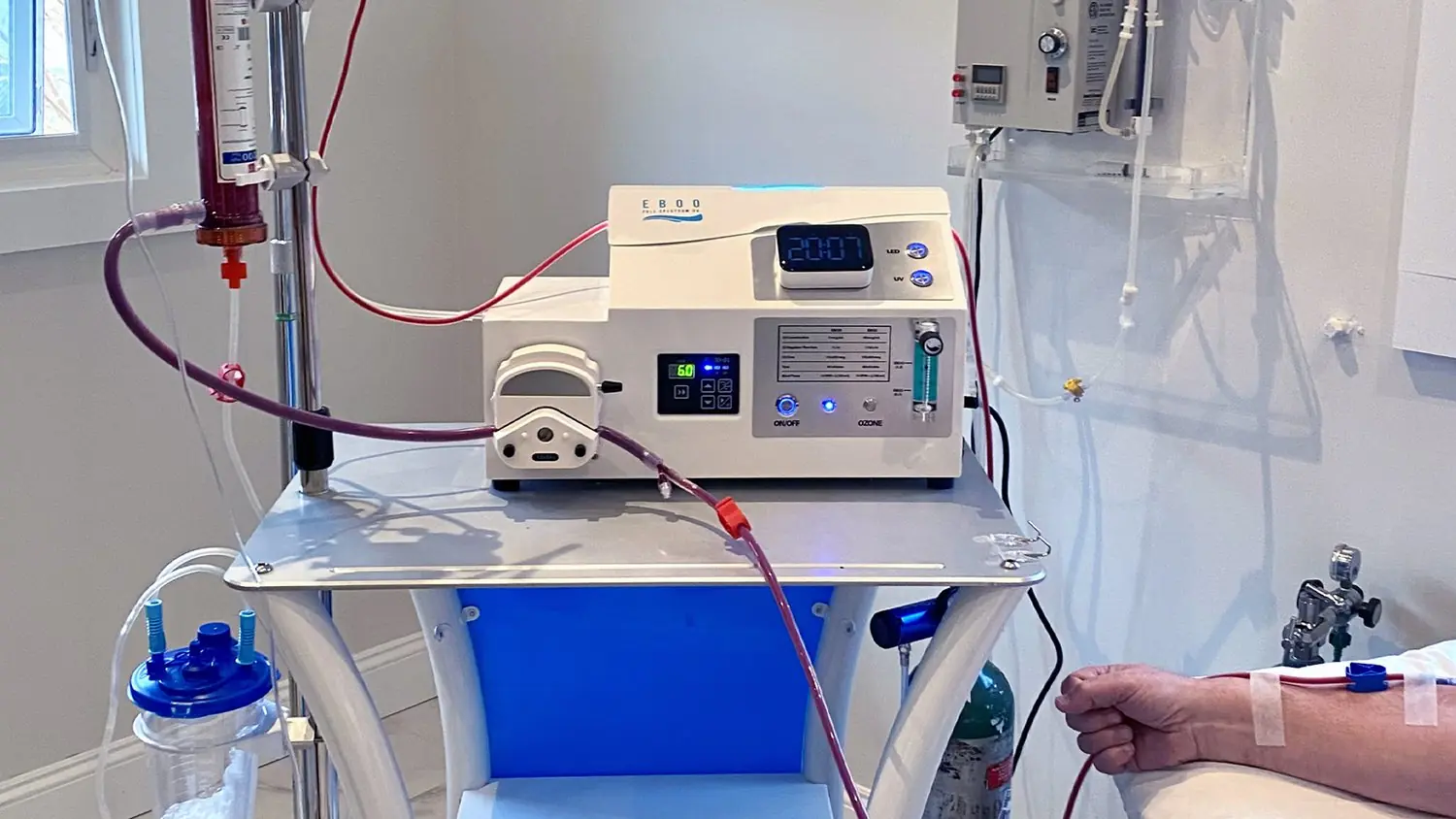
- The “Blood Change”: EBOO is a continuous flow system. It does not push blood back and forth in a syringe. Instead, it circulates your blood through a specialized filtration device (dialyzer) that:
- Filters out heavy metals, fats, and inflammatory debris.
- Saturates the blood with oxygen and ozone.
- Returns the clean, oxygenated blood to your body in a continuous loop.
Key Takeaway: EBOO vs 10 Pass Ozone comes down to filtration. 10 Pass adds ozone to dirty blood. EBOO cleans the blood while adding ozone.
Is EBOO the Same as Dialysis?
Because EBOO uses a machine that resembles a dialysis unit, many patients ask: “Is EBOO dialysis?”
The short answer is no, but they share similar technology.
- Dialysis is a life-support treatment for patients with kidney failure. Its sole purpose is to remove urea and excess water because the kidneys cannot. It is a maintenance therapy, not a regenerative one.
- EBOO is a regenerative therapy for people with functioning kidneys. While it uses a dialysis filter to catch toxins (like heavy metals, mold mycotoxins, and dead pathogens), its primary goal is to oxygenate and modulate the immune system.
Think of Dialysis as keeping the car engine from overheating. Think of EBOO as a complete oil change and engine tune-up to make the car run faster.
You might want to read: Is EBOO Different from Dialysis?
Comparing the Stats: Volume and Efficiency
When evaluating EBOO vs Ozone Blood Therapy methods, volume matters. The average human body has about 5 liters of blood. To get a systemic effect, you need to treat as much of that volume as possible.
| Feature | MAH (Standard) | 10 Pass Ozone | EBOO Therapy |
| Blood Volume Treated | ~200 ml | ~1,500 – 2,000 ml | 1,800 – 3,000+ ml |
| Filtration Capability | None | None | High (Filters debris) |
| Procedure Time | 30-45 Mins | 60-90 Mins | 45-60 Mins |
| Method | Gravity Drip | Vacuum/Pressure (Syringe) | Continuous Flow (Pump) |
| Cellular Stress | Low | High (Due to pressure) | Low (Gentle flow) |
Why Choose EBOO Over Other Methods?
1. The “Waste Color” Factor
One of the most unique aspects of EBOO is the visual evidence. Because EBOO uses a physical filter, patients can actually see the toxins being removed. The filter often turns a dark, sludge-like color by the end of the session—visual proof of the bio-film, cholesterol, and debris leaving your system. You do not get this with 10 Pass or MAH.
2. Chronic Conditions (Lyme, Mold, Autoimmune)
For patients searching for EBOO for Lyme or EBOO for Mold Toxicity, the filtration aspect is critical. When you kill parasites or bacteria (a “die-off”), they release endotoxins. If you use 10 Pass Ozone, those dead toxins remain in your bloodstream until your liver processes them. EBOO helps filter this debris out immediately, often reducing the severity of the “Herxheimer” (detox) reaction.
3. Cardiovascular Health
For those looking at EBOO vs ECMO or cardiovascular support, EBOO’s ability to filter fats and improve blood rheology (flow) makes it superior to simple ozone injection. It physically helps “thin” sludge-like blood, improving micro-circulation to the brain and extremities.
The Verdict
If you are looking for a quick immune boost for a cold, standard MAH or 10 Pass may be sufficient.
However, if you are dealing with chronic inflammation, autoimmune issues, or simply want the most comprehensive full-spectrum blood cleansing available, EBOO is the superior choice. It is the only therapy that combines the oxygenating power of ozone with the detoxifying power of filtration.
Ready to experience the difference?
Browse among our comprehensive directory of certified EBOO Therapy Clinics and find the one closest to your town here.